
The ten components of board responsibility described in a recent series of articles require more than an appreciation for the idea of responsibility. They also incorporate the concepts of authority and accountability into an effective leadership role for a board of directors.
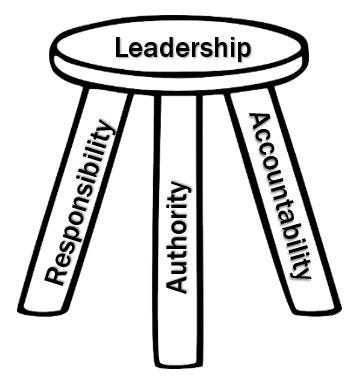
In any leadership situation, whether that of a corporate CEO, an Army commander, a superintendent, or the school board acting as one in its collective leadership role, the effectiveness of the leader depends on an inseparable and mutually reinforcing trio of responsibility, authority, and accountability. As in a three-legged stool, all three legs of this trio must be in balance, or the leadership is unstable. A school board, with state-sanctioned authority over the community’s schools, is itself in such a leadership situation. When astride this leadership stool, it must learn to create and nurture balance among all three legs if it is to be successful in its governance role. The board must also understand that success in the management role of a superintendent depends on a similar process of creating and maintaining balance in the superintendent’s own leadership three-legged stool.
Many school boards pay little or no attention to this balance, and some boards - because of a limited understanding of leadership - ignore one or more of these legs entirely. They do so at their own risk.
Some examples:
A fully “hands-on” board that is reluctant to delegate focuses on and stubbornly holds on to full decision-making authority over all matters. It does so while at the same time publicly declaring its intent to hold the superintendent fully accountable for results. This is a formula for failure in leadership. It creates imbalance, leading to an impossible situation for its superintendent, and the whole district suffers as a result. Indeed, such a board creates an impossible leadership situation, because it is undermining the very authority needed to accomplish organizational goals.
Another board, fearing the negative effects of micromanagement, might take a fully “hands-off” approach. After hiring what it hopes is a well-qualified candidate for superintendent, this board willingly and unthinkingly relinquishes its leadership role, granting (for a time) nearly total autonomy, in a kind of “magical thinking” strategy that can only be described as “hire and hope.” Full responsibility and full authority may be in balance here, but in the afterglow of the hiring process accountability is assumed or forgotten entirely and becomes an afterthought for this board to be dealt with later - sometimes not at all. Again, the board’s action creates an imbalance that leads eventually to failure.
Either of the above two boards has made itself vulnerable to a predictably reflexive reversal-of-direction at the first sign of trouble. When it reacts and suddenly switches between loosening and tightening the reins of power, such a reflexive reaction creates the sort of disaster the board thought it was avoiding when it adopted its prior stance.
Sometimes because of the board culture – the traditions and routines of meetings, for example – boards can veer off in unintended directions. For example, a board’s behavior in meetings - maybe prompted by the current public mood or influenced by a populist notion of board action that might be referred to as the ‘flavor of the month’ - may give to the public an impression that the superintendent is either incapable of responsible action, or alternatively that the superintendent is independently and fully in charge of district actions and outcomes. The board may harbor an expectation that any matter of significance (never clearly defined) should be brought forward by the administration for prior approval - in “Mother, may I?” fashion. Even after reviewing, tinkering with, then approving staff recommendations, the board may still, as if it had played no role in those decisions, expect to hold the superintendent fully accountable for the results of their decisions.
Still other boards abdicate their responsibility entirely, letting the superintendent take the initiative, and control not only the district’s work but the work of the board itself. These boards fail to even think about their own role in accountability and leave the superintendent in the awkward position of guiding or even “supervising” the board in its own leadership role. Such position is untenable, because the board at any time, when it comes under pressure, is likely to turn on the superintendent and withdraw its blind support.
A carefully crafted and balanced approach to the board’s leadership role exists when the board fully understands and balances its three-legged stool of responsibility, authority, and accountability, while remaining fully aware of the superintendent’s own three-legged stool, as one link in the chain of command of leaders throughout the district. An effective board is one that explicitly defines both its own role of leadership and that of the superintendent, one step down in the chain of command. It assigns clearly defined responsibility to the superintendent for the work of staff (retaining full responsibility at the board level for its own work) and delegates to the superintendent sufficient authority (with needed resources, freedom of action, and support) to carry out that responsibility and get the job done. It follows up such delegation of authority by holding the superintendent accountable for decisions made while exercising that board-delegated authority. It also exercises the self-discipline of holding itself accountable for board level responsibilities, decisions made at the board level of authority, its relationship with the superintendent, and the overall success of the district.
Another way to look at each leg of the leadership stool is to examine its direction.
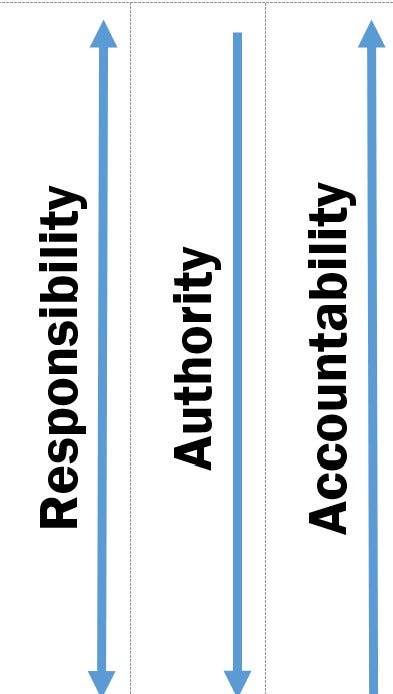
Responsibility is a two-way phenomenon: Looking upward, we are responsible to those above us, those who have assigned us responsibility for our work. Looking downward, we are responsible for those below, who do the work we cannot do by ourselves. The same is true of the superintendent, who is responsible to the board and responsible for the work of staff. The primary distinction between responsibility and authority is that while authority can be delegated, responsibility cannot. No matter how one chooses to carry out responsibility (whether authority is delegated or not) the board’s responsibility remains at the board level. Responsibility can be assigned to the superintendent, but it cannot just be given away and thereafter ignored by the board.
Authority. Whatever one’s level of responsibility, it must be matched by a comparable amount of authority granted (authority is delegated downward, from superior to subordinate) to empower/enable us to carry out that responsibility. Decision-making power and access to needed resources are both part of this idea of authority. The board must delegate sufficient authority to its primary subordinate to get the superintendent’s job done. Similarly, the superintendent must assign certain levels of responsibility to staff at lower levels in the chain, and the superintendent must delegate sufficient authority to staff to get the staff work done.
Accountability is essential to ensure we answer for decisions made and actions taken while exercising that delegated authority. Accountability has an upward direction because the person held accountable must answer to those who are above them in the chain, those to whom the person is responsible. The board holds the superintendent accountable, just as the superintendent holds staff accountable. The board also has a duty, acting on behalf of the public, to hold itself and its individual members accountable for responsibility that has been assigned to them.
Case Study. At every level we must keep in mind the trio of responsibility that is assigned, authority that is delegated, and accountability that is demanded. Good intentions are not enough. Actions matter. Results matter. Disruption in the balance of this trio can occur at any time.
Linda was elected with a proven track record as a community problem solver. Upon joining the board, she set out to identify issues that needed addressing by visiting schools, interviewing staff, listing concerns she heard and reporting them to the board. She followed this routine for a couple of weeks. It happened that the superintendent was at the time engaged in negotiations to renew the teachers’ contract. Union leaders got wise to Linda’s routine and began prepping staff on the day before she arrived at each school she was to visit. Linda was greeted with detailed bargaining issues (agreements and disagreements that district and union representatives had discussed as they worked toward renewal of the contract), and she began raising them one at a time in board meetings. Trying to do the “right thing” had led her down a path of naively undermining carefully balanced tentative agreements between the superintendent and the union while negotiations were still underway. It took several years for the district to recover because Linda refused to admit her school visits were encouraging these “end run” tactics.
In this instance, a new board member unwittingly allowed herself to be used by union leaders to gain leverage at the bargaining table. Since bargaining was a function that had been assigned to the superintendent, the board had previously delegated to the superintendent authority needed to do that work, but its newest member undermined the superintendent by elevating those issues prematurely to the board room, in piecemeal fashion and without the benefit of context developed over time through the the give-and-take of negotiations. When this kind of disruption occurs, the board must restore balance in the superintendent’s responsibility, authority, and accountability. It must ensure that individual board members are not allowed to compromise the work of the board-as-a-whole, which had reserved to itself the responsibility of reviewing tentative agreements brought by the superintendent, not in piecemeal fashion but as a whole package.
Of course, in a bargaining situation the board could choose to limit the superintendent’s freedom of action in bargaining, but if it does so it reduces the superintendent’s ability to account for the results of bargaining. Whether the three legs of the leadership stool are long (indicating significant responsibility, authority and accountability) or short, the board must create and maintain balance.
Some boards might elect to allow board members “to sit at the bargaining table” along with administrators and union representatives. This decision could have the unintended effect of reducing the superintendent’s responsibility, authority and accountability in the bargaining process. It might also impact the board’s objectivity when reviewing tentative agreements that result. A board making such a decision should do so with its eyes wide open, knowing that when it reduces authority delegated to the superintendent in such an arrangement, the board takes greater “ownership” of the process and the details inherent in bargaining, as well as their results. When results of decisions that it has reserved to itself are not to the board’s liking, it must proportionately reduce the level of accountability to which it can reasonably hold the superintendent.
A three-legged stool cannot remain stable without comparably proportioned and balanced legs. Boards that understand this balance in a leadership context will pay careful attention to balance in the responsibility they assign, the authority they delegate, and the accountability to which they hold the superintendent.
In summary, we must fully understand the differences between three equally important concepts of responsibility that the board must accept (and responsibility that the Board chooses to assign), authority that the Board is given by law and by the voters (and that which the Board must delegate if it is to fully meet is responsibility), and accountability that assures the Board (and the district) will answer for responsibility assigned and authority delegated.
The next post will describe four domains of the Board’s governance responsibility - broad areas within which all Board responsibilities can be found.
Source:
A Framework for School Governance (2017) Rick Maloney
Rick Maloney
www.governance101.com